
What if computers could solve problems that are impossible today? Imagine discovering life-saving medicines in days instead of years. Imagine predicting climate solutions before disasters strike. Imagine communication networks that cannot be hacked. This is the promise of quantum computing, a new way of thinking about how we process information.
A simple way to understand quantum computing is this. Today’s computers work step by step, like checking answers one by one in a long list. A quantum computer is different. It can explore many possible answers at the same time. It is like trying to find the best route in a city not by testing each road separately, but by considering many routes together and quickly narrowing down the best one. Another way to think about it is decision making. A normal computer tries different options one after another. A quantum computer can consider many options together and move toward the best answer faster. At the heart of this is a simple idea. Regular computers use bits, which are like a coin that is either heads or tails. Quantum computers use qubits, which are more like a spinning coin. While it is spinning, it is not just heads or tails, but has aspects of both at the same time. This allows quantum computers to work with many possibilities together instead of one at a time.
For many years, this idea belonged mostly to theory. It lived in textbooks, labs, and thought experiments. But something has changed. Today, quantum computing is beginning to take shape in the real world. Labs, companies, and governments are building working machines. The shift has begun, and that is why there is so much excitement. It is no longer science fiction. It is still early, but the progress is steady and visible.
The signs of this shift are already around us. Experiments in quantum teleportation have shown that information can be transferred across distance using special quantum connections, pointing toward a future quantum internet. New quantum sensors are now sensitive enough to detect signals inside biological systems, opening the door to studying processes within cells. India has demonstrated secure quantum communication over more than 1,000 kilometres using its own technology, showing that large scale secure networks are possible. At the same time, new research suggests that quantum computers may be able to break today’s encryption sooner than expected, which is pushing the development of quantum safe security systems. Each of these breakthroughs may seem small on its own, but together they signal something important. Quantum technology is moving out of the lab and into the world.
So what does this mean in practice? The potential impact is wide and far reaching. In healthcare, quantum computers could help design drugs by simulating molecules directly. In climate and energy, they could help discover better materials for batteries and clean energy systems. In cybersecurity, they will change how we protect information. In logistics, they can optimize complex systems like traffic and supply chains. In artificial intelligence, they may help process large and complex datasets more efficiently. The promise is not just faster computation. It is the ability to solve problems that are currently out of reach.
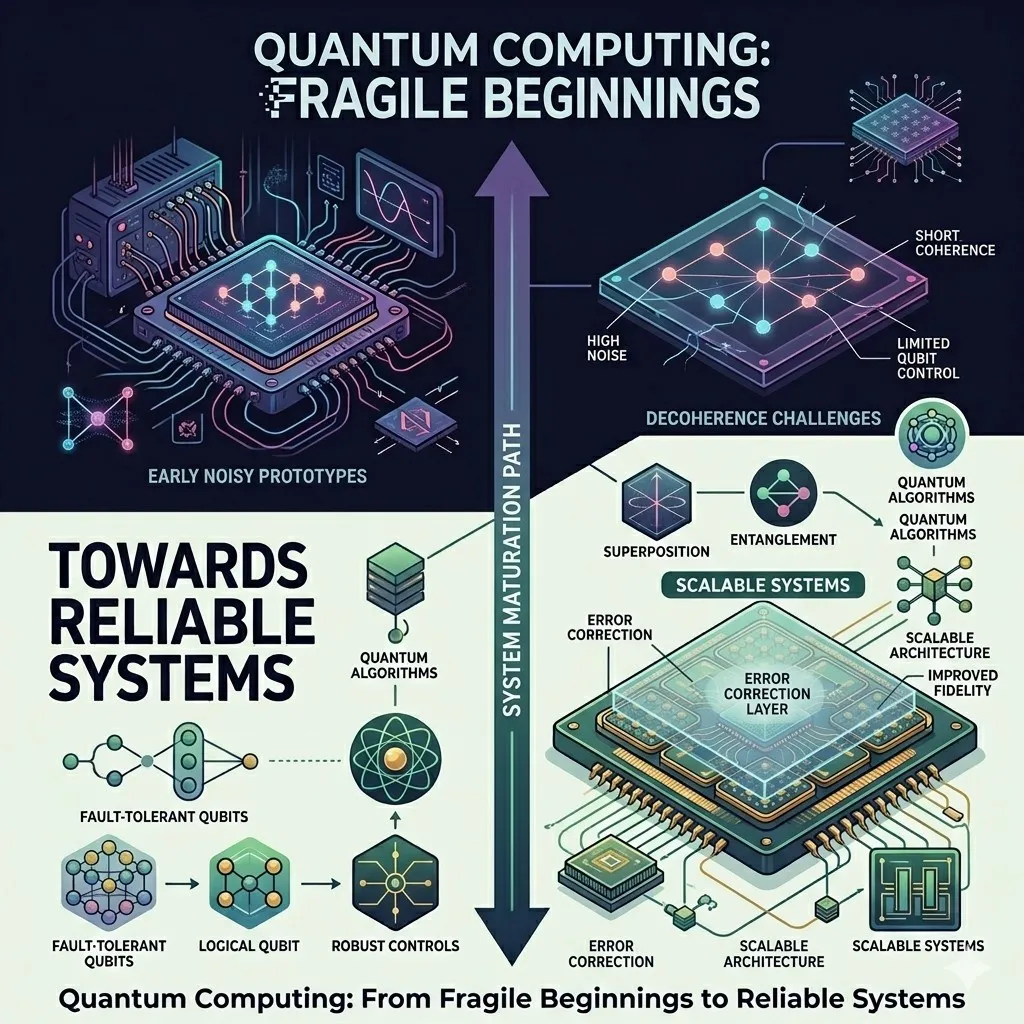
But if the promise is so powerful, why is quantum computing not already transforming our world? The answer lies in a fundamental challenge. Quantum systems are extremely sensitive, and even the smallest disturbance can destroy the information they carry. This is not just a technical issue. It is the central barrier that separates today’s experimental machines from truly useful quantum computers. Building a quantum computer is not just about making it work. It is about making it work reliably.
Instead of trying to eliminate every source of error, which is practically impossible, researchers are learning how to live with them. This is where quantum error correction comes in. Information is not stored in a single fragile unit, but spread across many physical qubits in a structured way so that it can be protected and recovered even when parts of the system fail. In a sense, the goal is not perfection, but resilience. This idea changes everything. A useful quantum computer will not be a perfect machine. It will be a system designed to operate reliably despite imperfections. This is why the focus of the field is shifting. It is no longer just about increasing the number of qubits. It is about improving their quality, their connections, and the ability to correct errors efficiently. The challenge is to move from many noisy qubits to fewer, but highly reliable logical qubits that can support long and meaningful computations.
This is where the journey becomes truly exciting. According to current roadmaps, including those outlined by IBM, the path to large scale quantum computing is not a single leap, but a layered progression. Advances in hardware, system design, and software must all come together. More stable qubits must be built. Better architectures must be designed to connect them. New methods must be developed to control and operate these systems in real time. At the center of this vision is the idea of logical qubits. These are protected units of quantum information built from many physical qubits working together. Creating even one high-quality logical qubit is a major milestone. Scaling this to hundreds or thousands is what will unlock real world applications. This shift from physical to logical qubits is one of the most important transitions in the field.
The turning point in this journey is fault-tolerant quantum computing. This is the stage where quantum computers become stable, scalable, and truly useful. They can run long and complex calculations without breaking down. This is when the most powerful quantum algorithms become practical. Problems such as simulating complex chemistry, designing new materials, or solving large optimization challenges will finally become accessible.
Reaching this stage will take time, and it will happen step by step. Early systems with a small number of logical qubits will demonstrate reliability. Over time, these systems will grow in scale and capability. Each step will unlock new possibilities. This journey mirrors the evolution of classical computing, where early unreliable machines gradually became the dependable systems we use today. What makes this moment especially important is that the path forward is still open. There is no single solution, and no single discipline that will solve it. Progress will come from many directions. From materials and device physics to control systems and electronics. From algorithms and computational theory to the integration of classical and quantum systems. Even areas like measurement efficiency and data handling remain critical challenges.
In many ways, we are still building the foundations. The transition to fault-tolerant quantum computing is not just another improvement. It is the defining step that will turn quantum computing from a scientific curiosity into a practical technology. For those entering the field today, this is not just about using quantum computers in the future. It is about helping build them. And this effort is already underway. Companies like IBM and Google are investing heavily. Startups are exploring new ideas. Governments around the world, including India, are building national programs. This is no longer a niche field. It is a global effort.
In the years ahead, quantum computing may not always be visible. It may work quietly in the background. Hospitals may use quantum designed drugs. Communication systems may become fundamentally secure. Climate models may become more accurate and guide better decisions. Most people may never directly interact with a quantum computer, but its impact will be felt everywhere. Quantum computing is not fully here yet. But it is no longer distant. Step by step, the technology is moving from fragile beginnings toward reliable systems. The future is not just imagined. It is being built.